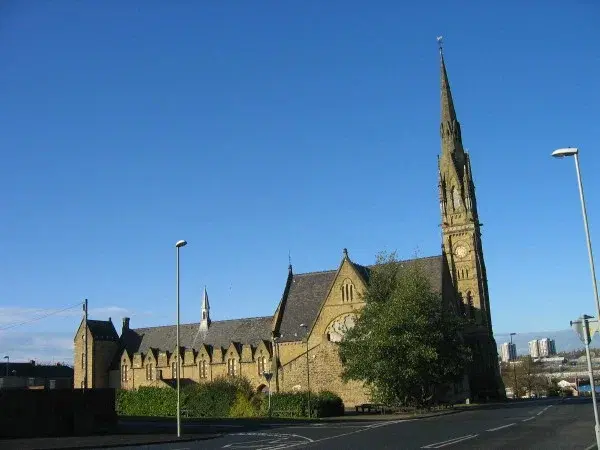
A Heritage Walking Trail in Hebburn
A self-guided walk linking Hebburn's industrial past: the shipyard riverside, St Andrew's Church, Hebburn Hall, Carr-Ellison Park and the town's war memorial.
Hebburn wears its history quietly. Much of the shipbuilding and mining that made the town has been swept away, but the traces are still there for anyone who knows where to look, from a shipbuilder's church with a soaring spire to the parkland an old landed family gave to the town. This self-guided walk links the main heritage sites in a sensible loop. It is a suggestion rather than a way-marked route, so check opening times and access for yourself before you set off, and treat the private buildings with respect.
Allow two to three hours at an easy pace, with time to stop and look.
1. Hebburn Riverside Park
Begin at the river, where Hebburn's story really starts. Hebburn Riverside Park, off Prince Consort Road, sits on around 75 acres of reclaimed land where the shipyards once stood. A riverside walk runs along the Tyne, and a jetty opened in 2004 reaches out over the water for a wide view up and down the river.
Stand on the jetty and picture the scene a century ago: cranes, slipways and half-built hulls lining this bank, and the noise of riveting carried across the water. It was from yards along here that Hawthorn Leslie launched HMS Kelly and countless other ships. For the full story, see our guide to Hebburn's shipyards and HMS Kelly.
Best for: Hebburn Riverside Park stands on reclaimed shipyard land. Its jetty, opened in 2004, gives the best public view of the Tyne in the town.
2. St Andrew's Church
Walk up from the river into the town and make for St Andrew's Church on Church Street, its slender spire visible from much of Hebburn. The church was built in 1872, paid for by the shipbuilder Andrew Leslie for the workforce he had brought to his new town. It was a Presbyterian church, later United Reformed, and its scale and quality say a great deal about the wealth and paternalism of Victorian Hebburn.
The building's second life is one of the more unexpected chapters in the town's story. After refurbishment it reopened in 2015 as a Buddhist meditation centre in the Dhammakaya tradition. A church raised by a Scottish shipbuilder for his Tyneside workers is now a place of Buddhist practice. It is a working religious centre rather than a museum, so admire the exterior and visit only during its public sessions or events.
3. Hebburn Hall
A short walk brings you to Hebburn Hall, the old seat of the Ellison family who held the estate for generations and drew the royalties from the coal beneath the town. The mansion was rebuilt in grander style in 1790 by the architect William Newton and later improved, around 1819, by the celebrated Tyneside architect John Dobson.
The Hall is now private, converted into residential apartments and houses, so please view it only from the public path and do not enter the grounds. Its interest is in what it represents: the landed family whose coal and land made Hebburn's industry possible, and whose name lives on in the park just beyond.
4. Carr-Ellison Park
Continue to Carr-Ellison Park, the town's great green landmark and the former gardens of Hebburn Hall. When the estate passed by inheritance in 1870 to Ralph Carr of Dunston Hill, he took the family name to become Carr-Ellison. In 1920 the family gave around 25 acres to the crowded industrial town as a public park. It opened as Hebburn Park and was later renamed Carr-Ellison Park in the family's honour.
This is a good place to pause. The park was a breathing space meant for the very miners and shipyard workers who built Hebburn, and it still does that job today, with mature trees, gardens, play areas and sports facilities.
Best for: Carr-Ellison Park was given to Hebburn in 1920 by the Carr-Ellison family. It began as the private gardens of Hebburn Hall.
5. The War Memorial
Within Carr-Ellison Park stands Hebburn's war memorial, a dignified monument to the townspeople who died in the two world wars. For a shipbuilding and mining town that sent so many men to sea and to the front, and lost so many with the sinking of HMS Kelly and other Tyne-built ships, it is a fitting place to end the walk in quiet reflection.
6. The Mountbatten Shopping Centre
Finish in the town centre at the Mountbatten Shopping Centre. It is an ordinary high-street precinct, but its name is a deliberate memorial: it honours Lord Mountbatten, captain of the Hebburn-built HMS Kelly. It is a neat closing of the circle, the town's most famous ship remembered in the middle of everyday shopping, a short walk from the river where she was launched.
Practical Information
- Distance: roughly 2 to 3 miles depending on the exact route between sites
- Time: two to three hours at an easy pace
- Terrain: paved streets and park paths throughout, with some gentle slopes up from the river
- Public transport: Hebburn Metro station, on the Yellow Line, is central and step-free
- Access notes: St Andrew's is a working meditation centre and Hebburn Hall is private housing; view both respectfully. The parks are free and open to the public.
For more background, read our guides to Hebburn's shipyards and HMS Kelly, the town's broader shipbuilding and mining heritage, and famous people from Hebburn.
Know a site we've missed? Get in touch and we'll add it.
Local businesses mentioned
Hebburn Riverside Park
Prince Consort Road, Hebburn, NE31 1BD
St Andrew's Church (Dhammakaya Meditation Centre)
Church Street, Hebburn, NE31 1DR
Hebburn Hall
Hall Grounds, Off Campbell Park Road, Hebburn, NE31 1QU
Carr-Ellison Park
Park Road, Hebburn, NE31 1LJ
Mountbatten Shopping Centre
Station Road, Hebburn, NE31 1LE
Never miss what’s on
Join the weekly Hebburn.live digest — the best events, news and local tips, straight to your inbox. Free, one email a week.
What's On
Arts and Craft Club at Hebburn Central Library
4:30 PM · Hebburn Central Library, Glen Street, Hebburn, NE31 1AB
Hebburn Town v Scarborough Athletic
7:45 PM · The Trustmark Group Stadium, 16 South Drive, Hebburn, NE31 1UN
Hebburn Town v Harborough Town
3:00 PM · The Trustmark Group Stadium, 16 South Drive, Hebburn, NE31 1UN