Hebburn's Shipbuilding and Mining Heritage
Coal, ships and steel on the south bank of the Tyne: the story of Hawthorn Leslie, HMS Kelly, Hebburn Colliery, and landmarks from Hebburn Hall to Carr-Ellison Park.
For most of the nineteenth and twentieth centuries, Hebburn was a town defined by two things: coal beneath the ground and ships on the river. The Tyne's south bank here was a working waterfront of slipways, cranes and pit heaps, and townsfolk spent their lives cutting coal or building the vessels that carried it away. That industry has largely gone, but its marks are everywhere, from the name of the shopping centre to the fabrication sheds rising again on the old shipyard land. This is the story of how Hebburn was built, and who built it.
Andrew Leslie and the Birth of the Shipyard
The town's shipbuilding history begins with one man. In 1853, Andrew Leslie arrived on the Tyne from Aberdeen and established an iron shipbuilding yard on land leased from the Ellison estate at Hebburn. It was a bold move: Hebburn was then a small place, and Leslie effectively built a town around his yard, putting up housing, a school and a church for his growing workforce.
The enterprise thrived. By the time Leslie retired in 1885, his yard, A. Leslie and Company, had launched around 255 ships. In 1886 the shipbuilding business merged with the Newcastle locomotive and marine-engineering firm of R. and W. Hawthorn to form R. and W. Hawthorn Leslie and Company, one of the great names of Tyneside industry. The combined firm built ships at Hebburn and engines at St Peter's in Newcastle, and it would keep the Hebburn slipways busy for more than a century.
HMS Kelly and the Mountbatten Connection
Of all the vessels launched at Hebburn, none is more famous than HMS Kelly. She was a K-class destroyer built by Hawthorn Leslie and launched in 1938, and her renown comes from her captain: Lord Louis Mountbatten, who commanded her from her commissioning until her loss. The Kelly led a dramatic wartime career, surviving torpedo and mine damage more than once and limping back to the Tyne for repair, before she was finally sunk by German dive-bombers off Crete in May 1941 with heavy loss of life.
That story left a permanent mark on the town. When the modern shopping centre was built in Hebburn's heart, it was named the Mountbatten Shopping Centre in honour of the connection between the town's most famous ship and her captain. It is a quiet reminder, in the middle of everyday shopping, of the destroyer built by Hebburn hands.
Best for: HMS Kelly, launched at Hawthorn Leslie's Hebburn yard in 1938 and commanded by Lord Louis Mountbatten, gave the town's Mountbatten Shopping Centre its name.
Palmers and the Wider Tyneside Yards
Hebburn's yards did not exist in isolation. Just downriver at Jarrow, Sir Charles Mark Palmer had founded Palmers Shipbuilding and Iron Company in 1852, and Palmers' vast operation spilled along the south bank and merged with the growth of Hebburn itself. In 1911 Palmers leased, and in 1912 purchased, the neighbouring Robert Stephenson yard at Hebburn together with its large dry dock, using it for warship and merchant-ship production.
Palmers closed in 1933, a catastrophe that devastated nearby Jarrow and led to the famous Jarrow March of 1936. The Hebburn dry dock, however, survived: it was taken over and continued in use for ship repair as Palmers Hebburn Company, keeping the name alive on the river long after the parent firm had gone.
Hebburn Colliery: Coal Beneath the Town
Before the ships, there was coal. Hebburn Colliery opened in 1792 on the Ellison family's mineral royalties, and mining shaped the town for the next 140 years. The colliery grew to work several pits and drew families to Hebburn from across the region, filling the terraced streets that grew up around the pit heads.
Coal mining on the Tyne was dangerous and often deadly work, and Hebburn's pits took their share of lives over the decades. The colliery was also a site of scientific history: the pioneering chemist Humphry Davy is associated with early nineteenth-century safety-lamp experiments in the Hebburn area. Hebburn Colliery finally closed in 1932, ending a story that had run for 140 years.
St Andrew's Church: Built by a Shipbuilder
Among the buildings Andrew Leslie gave his new town was a church. St Andrew's was built in 1872, paid for by Leslie for the workers of his yard, and it stands as a rare survival of the paternalistic Victorian industry that created Hebburn. The building later passed out of Anglican use, and in a striking twist of history it was refurbished and reopened as a Buddhist meditation centre, associated with the Dhammakaya tradition. A church raised by a Scottish shipbuilder for his Tyneside workforce now serves as a place of Buddhist practice, one of the more unexpected chapters in the town's story.
Hebburn Hall and Carr-Ellison Park
Long before shipyards and pits, the land here belonged to the Ellison family, merchant adventurers of Newcastle who held the Hebburn estate for generations. Their seat was Hebburn Hall, a country mansion rebuilt in grander style in the late eighteenth century and improved in the early nineteenth by the celebrated architect John Dobson. The hall still stands, converted in modern times to residential use.
The family's most generous legacy is a green one. When the estate passed by inheritance in 1870 to Ralph Carr of Dunston Hill, he was permitted to take the name Carr-Ellison. He opened the hall's grounds to the public and, in 1920, gave 25 acres of parkland to the densely built industrial town. It opened as Hebburn Park and was later renamed Carr-Ellison Park in the family's honour, a breathing space intended for the very miners and shipyard workers who had made Hebburn what it was. Today the town's civic life centres on Hebburn Central, the modern leisure, library and community hub, along with local groups across the estates.
The Modern Twist: Energy on the Old Slipways
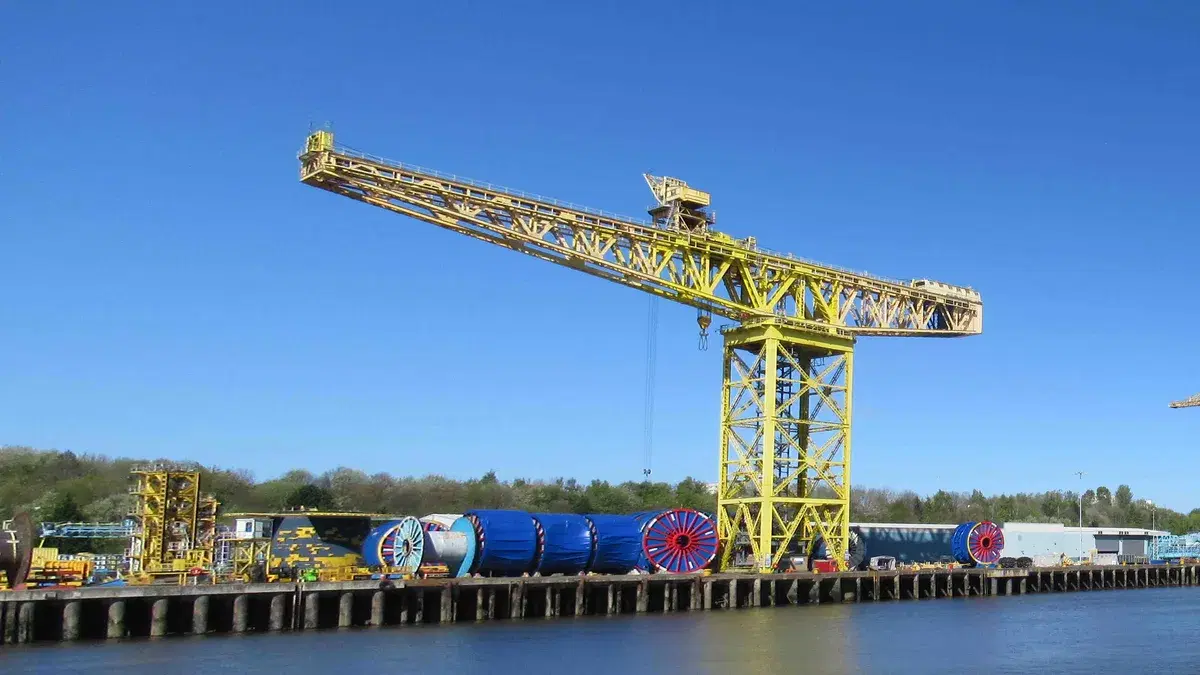
The shipyards fell quiet in the later twentieth century as the Tyne's great industries contracted, and for years the Hebburn riverside stood as a reminder of what had been lost. But the story has not ended. The riverside land where Hawthorn Leslie once launched its destroyers is again a place of heavy fabrication, this time serving the marine, energy and defence sectors from a modern complex of berths, laydown areas and cutting and rolling equipment.
South Tyneside has positioned this stretch of the Tyne at the centre of the region's offshore-energy ambitions, and the deep-water riverside that once built warships is now geared towards a new industrial era. It is a fitting continuity: the same skills of steel, welding and the water, applied to a different century.
Seeing Hebburn's Heritage Today
Much of Hebburn's industrial past has been swept away, but the traces reward a walk. Carr-Ellison Park remains the town's great green landmark; the Mountbatten Shopping Centre carries the name of the town's most famous ship; and St Andrew's Church still stands as Andrew Leslie's gift to the town he built. Down at the river, the modern fabrication yards occupy the ground where the slipways once ran.
Know something we've missed, or have old photographs of the yards and pits? Get in touch and we'll add it. Browse the local directory or see what's on in Hebburn this week.
Never miss what’s on
Join the weekly Hebburn.live digest — the best events, news and local tips, straight to your inbox. Free, one email a week.
What's On
Arts and Craft Club at Hebburn Central Library
4:30 PM · Hebburn Central Library, Glen Street, Hebburn, NE31 1AB
Hebburn Town v Scarborough Athletic
7:45 PM · The Trustmark Group Stadium, 16 South Drive, Hebburn, NE31 1UN
Hebburn Town v Harborough Town
3:00 PM · The Trustmark Group Stadium, 16 South Drive, Hebburn, NE31 1UN