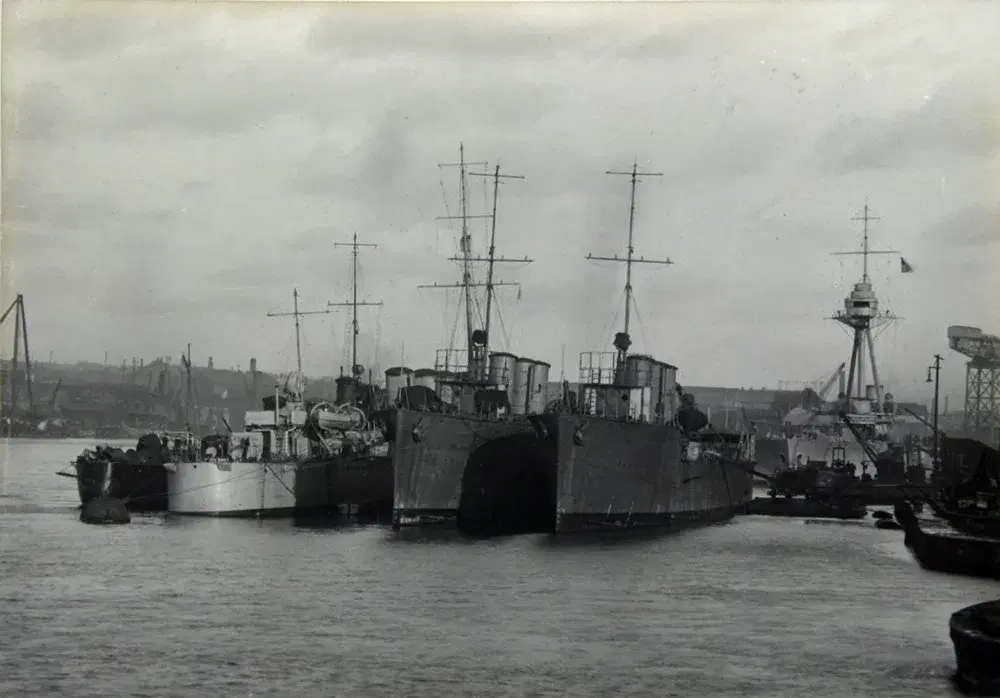
Hebburn's Shipyards and HMS Kelly
How Hawthorn Leslie built ships on the Hebburn riverside, the story of HMS Kelly and Lord Mountbatten, and why the town's shopping centre carries the destroyer's name.
For more than a century, the reach of the Tyne at Hebburn was a working shipyard. Where the riverside path now runs, cranes once leaned over slipways, riveters swarmed the plates of half-built hulls, and destroyers slid into the water sideways to the cheers of the town that made them. One of those ships became famous the world over. This is the story of the Hebburn yards, of the men who built there, and of HMS Kelly, the destroyer whose name the town still carries.
Andrew Leslie Starts a Shipyard
Hebburn's shipbuilding began with an incomer. Andrew Leslie, born in Shetland in 1818 and trading out of Aberdeen, came to the Tyne in 1853 and took a lease on land at Hebburn Quay to build iron ships. It was a gamble on a small place, and Leslie backed it by building a town to go with the yard, putting up housing, schools and a church for the workforce he brought south. So many of his men were Scots that the district earned the nickname "Little Aberdeen".
The yard, A. Leslie and Company, prospered through the great decades of iron and then steel shipbuilding. When Leslie retired in 1886, his business merged with the Newcastle locomotive and marine-engineering firm of R. and W. Hawthorn to form R. and W. Hawthorn Leslie and Company. From then on the combined firm built the hulls at Hebburn and the engines at St Peter's in Newcastle, a division of labour that kept the Hebburn slipways busy for another seventy years.
HMS Kelly and Lord Mountbatten
Of all the ships launched at Hebburn, none is remembered like HMS Kelly. She was a K-class destroyer, laid down in 1937 and launched from the Hawthorn Leslie yard on 25 October 1938. Her fame rests on her captain: Lord Louis Mountbatten, who commanded her and the 5th Destroyer Flotilla she led.
The Kelly had a short, dramatic life. She was mined and torpedoed more than once in the first months of the war and each time was brought limping back to the Tyne for repair by the yard that had built her. On 23 May 1941 she was caught by German dive-bombers off Crete and sunk, with around half her crew lost. Mountbatten survived. The ship's story was retold, only lightly disguised, in Noël Coward's 1942 film In Which We Serve, in which the fictional destroyer HMS Torrin stands in for the Kelly.
Best for: HMS Kelly was launched at Hawthorn Leslie's Hebburn yard on 25 October 1938 and commanded by Lord Louis Mountbatten. She was sunk by German dive-bombers off Crete on 23 May 1941.
Why the Shopping Centre Is Called the Mountbatten
That wartime story left a permanent mark on the town centre. When Hebburn's main shopping precinct was built, it was named the Mountbatten Shopping Centre after the man who commanded the town's most famous ship. It is an easy thing to walk past without a second thought, but the name is a small memorial in the middle of everyday shopping, a link between the modern high street and the destroyer that Hebburn hands riveted together on the riverside.
Palmers and the Neighbouring Yards
Hebburn's yards did not stand alone. Just downriver at Jarrow, Charles Mark Palmer had founded Palmers Shipbuilding and Iron Company in 1852, launching the pioneering collier John Bowes in the same year. Palmers grew into one of the giants of the Tyne, and in 1911 it leased, then in 1912 bought, the neighbouring Robert Stephenson shipyard at Hebburn, together with its large dry dock.
Palmers' Jarrow works closed in 1933, a collapse that threw thousands out of work and led to the Jarrow March of 1936. The Hebburn dry dock, though, outlived its parent: it carried on in ship repair as the Palmers Hebburn Company, keeping the old name alive on the river for years afterwards. It is worth being precise about the geography, because the two firms are often confused. Palmers was a Jarrow yard that reached into Hebburn; Hawthorn Leslie, the builder of the Kelly, was the Hebburn yard proper.
The Yards Fall Quiet
British shipbuilding contracted sharply in the second half of the twentieth century, and the Tyne felt it hard. The Hebburn slipways that had launched destroyers and merchantmen gradually fell silent, and for a long stretch the riverside stood as a reminder of an industry that had all but gone. The terraced streets that had housed the workforce remained, but the hammering across the water had stopped.
The Riverside Today
The story has not quite ended. The stretch of reclaimed riverside off Prince Consort Road is now Hebburn Riverside Park, a public green space with a walk along the water and a jetty, opened in 2004, that reaches out over the Tyne for a wide view up and down the river. Elsewhere along the same bank, heavy fabrication for the marine and energy sectors has returned to ground where the slipways once ran, putting the old skills of steel and welding to work for a new century.
For the wider picture, including the town's mining past and its landmark buildings, see our guide to Hebburn's shipbuilding and mining heritage. To trace the sites on foot, follow our Hebburn heritage walking trail, and read about the shipbuilder Andrew Leslie and others in famous people from Hebburn.
Have old photographs of the yards or a family connection to Hawthorn Leslie? Get in touch and we'll add it. Browse the local directory or see what's on in Hebburn this week.
Never miss what’s on
Join the weekly Hebburn.live digest — the best events, news and local tips, straight to your inbox. Free, one email a week.
What's On
Arts and Craft Club at Hebburn Central Library
4:30 PM · Hebburn Central Library, Glen Street, Hebburn, NE31 1AB
Hebburn Town v Scarborough Athletic
7:45 PM · The Trustmark Group Stadium, 16 South Drive, Hebburn, NE31 1UN
Hebburn Town v Harborough Town
3:00 PM · The Trustmark Group Stadium, 16 South Drive, Hebburn, NE31 1UN