HMS Kelly: The Story of Hebburn's Most Famous Ship
Built at Hawthorn Leslie's Hebburn yard, mined, torpedoed, towed home and rebuilt by the men who made her, then lost off Crete in 1941. The full story of HMS Kelly and why Hebburn still remembers her.
Plenty of towns built warships. Few had a warship come back to them, again and again, broken and listing, to be mended by the same hands that had riveted her together. HMS Kelly was built on the Hebburn riverside, and in less than two years of war she returned to the Tyne for repair more often than she sailed out of it. Twenty of her crew are buried in Hebburn Cemetery. Her name is on the shopping centre, a pub and a new riverside neighbourhood.
Our guide to Hebburn's shipyards gives the Kelly a couple of paragraphs. She deserves more than that. This is her story, from the slipway at Hawthorn Leslie to the seabed off Crete, and the ways the town has kept her memory since.
Built at Hawthorn Leslie
The Admiralty ordered the Kelly from R. and W. Hawthorn Leslie and Company on 24 March 1937. She was yard number 615 at the Hebburn shipyard, one of a new class of K-class destroyers, and her keel was laid on 26 August 1937.
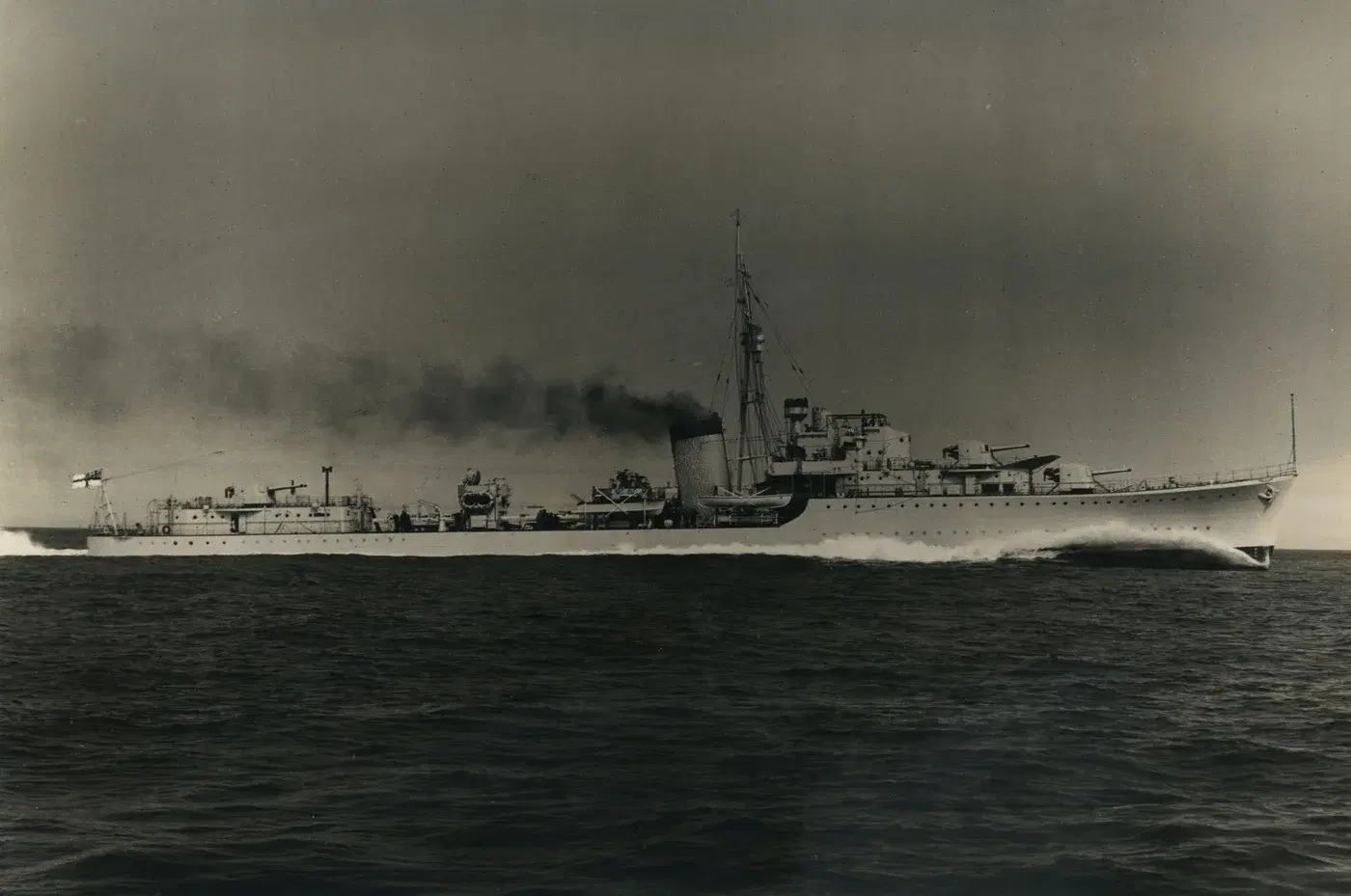
She was launched into the Tyne on 25 October 1938, less than a year before the outbreak of war. Hebburn had launched ships for generations, but this one was a flotilla leader: the ship that would carry the captain commanding a whole group of destroyers. The photograph at the top of this page, from the Tyne and Wear Archives, shows her running at full power on her trials in 1939, fresh out of the yard.
The Kelly was commissioned on 23 August 1939, just eleven days before Britain declared war on Germany. Her captain was Lord Louis Mountbatten, a great-grandson of Queen Victoria, who took command on 27 June 1939 and also led the 5th Destroyer Flotilla from her bridge.
Best for: HMS Kelly was laid down at Hawthorn Leslie's Hebburn yard on 26 August 1937, launched on 25 October 1938 and commissioned on 23 August 1939.
A royal passenger and a mine off the Tyne
One of her first jobs had nothing to do with fighting. In September 1939 the Kelly crossed to France to bring the Duke and Duchess of Windsor back to Britain, the former King Edward VIII returning home after his abdication.
The war found her soon enough. On 14 December 1939 she was escorting tugs out to the tanker Atheltemplar, which had struck a mine off the mouth of the Tyne, when the Kelly hit a mine herself. Her hull was damaged and she was towed back up the river, almost within sight of where she had been built. The repairs were carried out at Hawthorn Leslie's yard, and she was not finished until the end of February 1940.
She was back at sea for only a few days. On 2 March 1940 she collided with another destroyer, HMS Gurkha, and spent the next eight weeks in dry dock on the Thames. She came out on 27 April, in time to help evacuate Allied troops from Namsos in Norway.
Torpedoed in the North Sea
The night of 9 May 1940 is the part of the story Hebburn remembers most closely. At around half past ten, in the North Sea, a German E-boat fired a torpedo that struck the Kelly amidships. The damage was so severe that many would have expected her to sink.
She didn't. The destroyer HMS Bulldog took her in tow. Shortly after midnight, in fog, a second E-boat ran into both ships, adding damage to the Kelly's bow. Her wounded were transferred to HMS Kandahar, and she was dragged slowly westward.
For four days the Kelly crept across the North Sea at little more than walking pace, around three knots, while German aircraft and E-boats came back to attack. Tugs relieved Bulldog on 12 May, and with an escort of destroyers around her, the Kelly reached the Tyne at half past five on the evening of 13 May 1940.
Twenty-seven of her crew had been killed in the torpedo attack.
The grave at Hebburn Cemetery
Twenty of the men killed that night were brought ashore and buried together in a single collective grave in Hebburn Cemetery, in the town where their ship had been built.
The headstone that stands over them is a three-panelled memorial with an anchor carved into its central panel. It was put up jointly by the officers and men of the Kelly and the workmen of the Hebburn shipyard, a detail that says a great deal about how close the ship and the town had become. One plaque remembers the 27 men killed off the German minefield in May 1940. Another remembers those lost a year later off Crete.
The grave is recorded by the Commonwealth War Graves Commission, and it is the focus of a short service each year as part of Remembrance Sunday in Hebburn.
Rebuilt by the men who built her
The damage was so severe that the Kelly was decommissioned and handed back to Hawthorn Leslie for rebuilding. For the second time in six months, Hebburn's shipwrights took her apart and put her back together.
The work took until December 1940. By then the Kelly had been in action for less than two weeks out of the previous fourteen months, an extraordinary record of bad luck for a brand-new ship. Yet each time she was hit, she stayed afloat and came home, and each time the yard that built her made her whole again. For the workforce on the riverside, the Kelly was not just another hull that had left the slipway; she was their ship.
The last voyage: Crete, May 1941
Recommissioned and back with the 5th Flotilla, the Kelly was sent to the Mediterranean in the spring of 1941. She arrived at Malta at the end of April and spent the following weeks escorting convoys and, on 10 May, bombarding the port of Benghazi.
In late May the Germans launched their airborne invasion of Crete. On 21 May the Kelly was sent with HMS Kashmir and HMS Kipling to join the naval forces off the island, patrolling north of Crete through the night.
Early on 23 May, as the destroyers withdrew at full speed, they were found by German Stuka dive-bombers. The Kelly was hit and sunk. Kashmir was sunk too. The Kelly's guns kept firing to the end and are credited with bringing down attacking aircraft.
HMS Kipling turned back for the survivors. Under continuous air attack, she picked men out of the water, rescuing 279 officers and men from the two ships, Mountbatten among them, and carried them to Alexandria. Nine officers and 121 men of the Kelly were lost: 130 in all, around half her ship's company.
Best for: HMS Kelly was sunk by German dive-bombers south of Crete on 23 May 1941. Nine officers and 121 men were lost. HMS Kipling rescued the survivors, including Lord Mountbatten.
In Which We Serve
The Kelly's story did not end with her sinking. Mountbatten was a close friend of the playwright Noël Coward, and Coward used the ship as the basis for In Which We Serve, released in 1942. Coward wrote, co-directed and starred in the film as the captain of a destroyer called HMS Torrin, with John Mills in the cast. Torrin's story, from the building of the ship to her loss off Crete, follows the Kelly's closely.
The film was one of the most celebrated British films of the war, and it meant that people who had never heard of Hebburn knew something of the ship built there.
Mountbatten went on to become Supreme Allied Commander in South East Asia, the last Viceroy of India and First Sea Lord. He was killed by an IRA bomb in 1979, and a plaque in his memory was later added to the Kelly grave at Hebburn Cemetery, alongside the men who served under him. The HMS Kelly Association has continued to hold reunions and acts of remembrance.
Where to find the Kelly in Hebburn today
The ship is never far away in Hebburn, even if you have to know where to look.
- Hebburn Cemetery. The collective grave and its memorial are the most direct link to the ship and her crew, and the most moving place to visit.
- The Mountbatten Shopping Centre. The town's main shopping precinct, the Mountbatten Centre, is named after the Kelly's captain.
- The Kelly pub. On Hedgeley Road, The Kelly is a community pub whose name nods to the destroyer.
- Hebburn Metro station. Artwork on the platforms at Hebburn station includes the ship among its scenes of local history.
- The riverside. The site of the old Hawthorn Leslie yard is being redeveloped as Kelly's Wharf, a riverside neighbourhood named after the yard's most famous ship.
If you want to put the Kelly in her wider setting, our heritage walking trail takes in the riverside and town centre, and Hebburn in the Second World War looks at how the war shaped the town at home. Hebburn Central, the town's library and leisure hub, is a good starting point for local history research.
Why the story still matters
There were bigger ships than the Kelly, and luckier ones. What makes her story Hebburn's own is the connection between the yard and the crew. The men who built her repaired her twice, buried her dead in their own cemetery and paid for the stone over the grave alongside the sailors who survived.
Eighty-five years after she was lost, her name is still part of everyday life in the town: on the shopping centre, over the pub door, and on the new streets going up where she was built.
Do you have a family connection to HMS Kelly, or memories of the Hawthorn Leslie yard? We would love to hear from you. Get in touch.
Never miss what’s on
Join the weekly Hebburn.live digest — the best events, news and local tips, straight to your inbox. One email a week.
What's On
Hebburn Town v Marine
3:00 PM · The Trustmark Group Stadium, 16 South Drive, Hebburn, NE31 1UN
Hebburn Town v Bedford Town
3:00 PM · The Trustmark Group Stadium, 16 South Drive, Hebburn, NE31 1UN
How I Made a Telly Show: The History of Hebburn
7:30 PM · The Customs House, Mill Dam, South Shields, NE33 1ES